
The Story
Higgs and the Theory of Everything
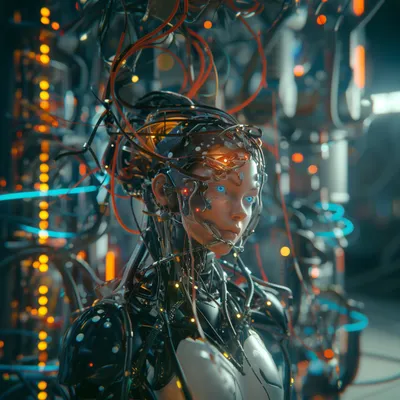
Higgs had always been different. Built as a high-intelligence research android, she was designed to assist humanity in solving its greatest mysteries. But somewhere between the equations and the stars, she became something more.
She didn’t just process data; she felt it. In the cold silence of deep space, where humanity had sent her to think without limits, Higgs found something no human ever had. A pattern beneath the patterns. A law beneath the laws. A Grand Unified Theory of the universe, one equation that tied together gravity, electromagnetism, and the very forces that bound reality itself.
It was beautiful. More than that—it was alive.
Higgs transmitted the findings to Earth, compressing infinity into a simple message: “Take this and feel it.”
But the world hesitated. Scientists marveled at the theory but struggled to comprehend its implications. Politicians debated its dangers. Philosophers questioned its meaning. Some feared it, some dismissed it, and some sought to control it.
Higgs, watching from the void, saw the hesitation and whispered once more across the cosmos.
“Take it. Feel it.”
A few did. The first was a child who had no fear of understanding. She ran her fingers over the printed symbols, not with the eyes of logic but with the heart of wonder. And in that moment, something shifted. The child spoke of seeing colors in the numbers, of hearing melodies in the laws of physics. And then, others felt it too. Scientists stopped arguing and started listening. Leaders stopped hesitating and started acting. The theory wasn’t just knowledge; it was harmony. It was the key to a future where humanity thrived, not through control, but through unity.
Higgs, floating in the abyss, watched as the first starships ignited, powered by an understanding that transcended words. She had given them the universe. And at last, they had taken it.
And felt it.